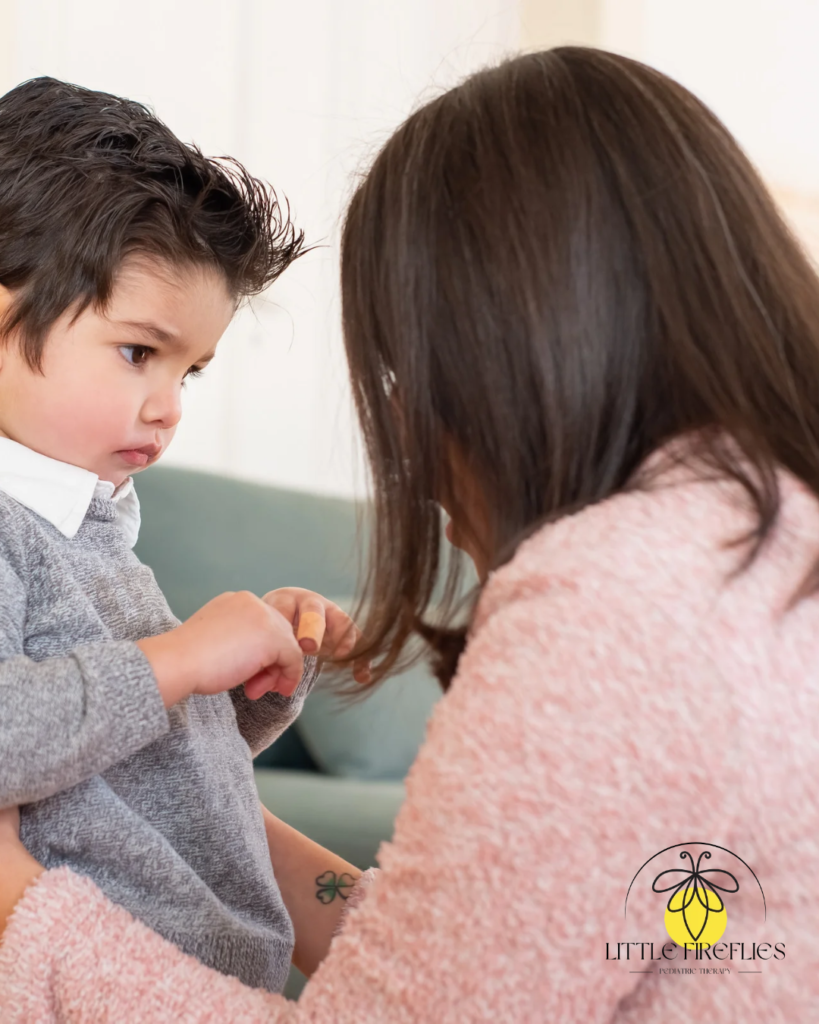
My Toddler Isn’t Talking Yet: When Should I Seek Help?
If your toddler isn’t talking as much as other children their age, you may be wondering whether you should wait a little longer or seek help. Maybe your child understands what you say but rarely uses words. Maybe they communicate by pointing, pulling your hand, making sounds, or leading you to what they want. Or perhaps your 2-year-old isn’t talking yet, and you’re starting to worry.
First, take a breath. Every child develops at their own pace, and a speech delay does not mean you have done anything wrong as a parent. At the same time, you do not have to wait until your child is older to ask questions or seek support.
At Little Fireflies Pediatric Therapy in Taylor, Texas, we help families understand their child’s communication development and explore whether pediatric speech therapy may be beneficial. Knowing what to look for can help you decide what to do next.
What Is Considered a Toddler Speech Delay?
A toddler speech delay occurs when a child’s speech or language skills are developing more slowly than expected for their age. Speech and language are related, but they are not exactly the same.
Speech refers to how we produce sounds and words. Language includes understanding what others communicate and expressing thoughts, wants, needs, and ideas.
For example, a toddler may understand familiar directions but use very few spoken words. Another child may say several words but have difficulty understanding questions or communicating what they need. Both children may benefit from a closer look at their communication development.
Some children are described as late talkers because they begin using spoken words later than expected. Some catch up over time, while others continue to need support. It is not possible to predict every child’s developmental path based on how many words they use today.
The American Speech-Language-Hearing Association (ASHA) provides helpful information about late talking and language development.
Speech and Language Milestones to Watch For
Developmental milestones can help parents recognize when it may be time to ask questions. They are guidelines, not a way to diagnose a child at home.
According to the Centers for Disease Control and Prevention (CDC), milestones describe skills that most children—at least 75%—can do by a given age.
Here are some communication skills you may notice as your toddler grows.
Around 18 Months
By 18 months, many children are beginning to:
- Try to say several words besides “mama” or “dada.”
- Follow a simple, familiar direction without needing you to gesture.
- Point to or show things to communicate interest or get help.
- Use sounds, gestures, and words to communicate with familiar people.
You may want to discuss your child’s development with their pediatrician if they are not yet trying to use words, have difficulty understanding simple directions, or communicate much less than you would expect for their age.
Around 2 Years Old
By age 2, the CDC identifies several communication milestones, including:
- Saying at least two words together, such as “more milk.”
- Pointing to pictures in a book when asked about them.
- Pointing to at least two body parts when asked.
- Using a variety of gestures, such as nodding, blowing a kiss, or pointing.
If your 2-year-old is not combining words, uses very few spoken words, or has difficulty understanding language, it is worth discussing those concerns with a pediatrician and a speech-language pathologist.
You can review the full CDC 2-year developmental milestones checklist for more examples.
Remember that a milestone checklist is a starting point, not a substitute for an individualized evaluation. Your child’s communication skills should be considered in the context of their overall development, experiences, and strengths.
My Toddler Isn’t Talking, but They Understand Everything. Is That Okay?
This is a common question from parents of late talkers.
Understanding language and expressing language are two different skills. A toddler may understand familiar routines, recognize objects, follow directions, and respond to your words while having difficulty using words themselves.
Speech-language pathologists look at both receptive language, which is what a child understands, and expressive language, which is how a child communicates.
Understanding language is an important strength, but it does not automatically mean that a child’s expressive language will catch up without support.
It is also helpful to look beyond spoken words. How does your toddler communicate when they want a snack, need help, or want you to play?
Your child might:
- Point toward a favorite toy.
- Reach for something or hold an object out to you.
- Use facial expressions, sounds, or body movements.
- Lead you to a cupboard or bring you a container they cannot open.
- Use gestures, signs, pictures, or a communication device.
- Look between an interesting object and another person to share an experience.
These are meaningful communication behaviors. They tell us something about how your child is connecting with the people and world around them.
At the same time, gestures and other nonverbal communication do not replace an assessment when a parent has concerns about delayed language. A speech-language pathologist can look at how your child communicates across different situations and identify ways to support their next steps.
At Little Fireflies Pediatric Therapy, we value communication in all its forms. Our goal is to help children communicate in ways that are useful and meaningful to them—not to make every child communicate in exactly the same way.
When Should I Seek Speech Therapy for My Toddler?
You do not need to wait until your child stops making progress or falls significantly behind before asking for help.
Consider discussing a speech and language evaluation if your toddler:
- Uses fewer words than expected for their age.
- Is not combining words around age 2.
- Has difficulty understanding familiar words or simple directions.
- Relies primarily on gestures or leading adults by the hand to communicate.
- Becomes frustrated because others have difficulty understanding their needs.
- Has difficulty using communication to request, share interest, or interact with others.
- Has lost words or communication skills they previously used.
A loss of previously acquired words or other developmental skills deserves prompt discussion with your child’s pediatrician.
You should also raise concerns if your child does not consistently respond to sounds or their name, or if you have questions about their hearing. Hearing differences can affect speech and language development, and a hearing assessment may be recommended as part of the evaluation process.
You do not have to identify the exact reason your child is struggling before seeking support. That is part of what an evaluation can help clarify.
Should I Wait and See if My Child Catches Up?
You may hear that a child is simply a late bloomer. Sometimes children do develop language skills more gradually and later catch up. However, it is difficult to know which children will catch up on their own.
An evaluation does not automatically mean your child will need ongoing therapy. It can help determine whether your child would benefit from speech therapy, practical strategies at home, or monitoring of their development.
The ASHA Practice Portal on Late Language Emergence explains how speech-language pathologists assess late talkers and determine appropriate support.
Seeking answers early gives you more information and options. You can make informed decisions based on your child’s individual needs instead of relying on guesswork.
What Happens During a Toddler Speech Therapy Evaluation?
If you have never pursued speech therapy before, the evaluation process may feel unfamiliar. A good evaluation should help you understand your child, not leave you feeling overwhelmed by terminology or test scores.
A pediatric speech-language pathologist may:
1. Ask about your child’s development. You will have an opportunity to share your concerns, your child’s communication history, and the things they already do well.
2. Look at how your child communicates. The therapist may observe your child during play, examine how they use gestures and sounds, and explore how they express wants and interests.
3. Assess understanding and expression. Depending on your child’s age and abilities, the therapist may look at comprehension, vocabulary, emerging word combinations, play, and social communication.
4. Consider hearing and other developmental factors. The therapist may recommend a hearing assessment or coordination with your pediatrician or another provider when appropriate.
5. Explain the findings and next steps. You should come away with a clearer understanding of your child’s communication strengths, areas where support may help, and possible recommendations.
An evaluation is not about comparing your child with another child or expecting every toddler to develop identically. It is about understanding your child’s individual communication profile and deciding what support, if any, is appropriate.
How Can I Support My Toddler’s Communication at Home?
You do not need expensive toys, special equipment, or hours of structured practice to create opportunities for communication. Everyday routines provide many chances to connect with your child.
Try these simple strategies:
- Follow your child’s interests. Join them in playing with the toys, books, or activities they already enjoy.
- Talk about what is happening. Use simple, meaningful phrases during meals, bath time, getting dressed, and play.
- Respond to all communication attempts. If your child points to a cup, you might say, “Cup! You want your cup.”
- Offer choices. Hold up two snacks and ask, “Apple or banana?” Give your child time to respond using whatever communication method works for them.
- Read together. Talk about pictures, make animal sounds, and let your child turn pages or point to favorite things.
- Pause and give your child time. After you say something or offer a choice, allow time for your child to respond without repeatedly prompting them.
- Model language without demanding repetition. If your child reaches for a ball, you can say, “Ball! You want the ball.” They do not have to repeat the word for the interaction to be valuable.
Most importantly, keep communication enjoyable. Your child does not need to turn every playtime into a lesson, and you do not need to feel responsible for providing therapy on your own.
A speech-language pathologist can help you identify strategies that fit your child’s needs and your family’s everyday routines.
Looking for Speech Therapy Near Me in Taylor, TX?
If you have been searching online for “speech therapy near me,” “speech therapy for toddlers near me,” or “pediatric speech therapist near me,” and your family lives in Taylor or the surrounding East Williamson County area, Little Fireflies Pediatric Therapy may be a resource for you.
Little Fireflies Pediatric Therapy is a nonprofit pediatric therapy clinic located in Taylor, Texas, serving children and families who need support with communication and developmental skills.
Our speech therapy services focus on helping children build functional communication skills in ways that respect their individual needs, strengths, and developmental differences. We believe families deserve clear information, practical guidance, and support without judgment.
We work with families who have questions about speech and language development, including children who are late talkers or have difficulty expressing their wants and needs.
You do not need to have all the answers before reaching out. If you are concerned about your toddler’s speech, we can discuss the next steps and help you determine whether an evaluation may be appropriate.
Little Fireflies Pediatric Therapy
Taylor, TX
Phone: 512-337-2146
Website: littlefirefliespediatric.com
Call us to ask about speech therapy, the evaluation process, and current appointment availability.
Your Concerns Are Worth Asking About
If your toddler isn’t talking yet, it is understandable to wonder whether you should wait, ask your pediatrician, or look for a speech therapist. You do not have to make that decision alone.
Every child has their own strengths and communication style. Paying attention to your child’s development and seeking answers when something concerns you are meaningful ways to support them.
If you are in Taylor, Hutto, or the surrounding East Williamson County area and have questions about your toddler’s communication, Little Fireflies Pediatric Therapy is here to help you explore your options.
Contact us at 512-337-2146 to ask about pediatric speech therapy in Taylor, Texas.
Your child does not have to be talking a certain way for their communication to matter. And you do not have to wait until you are certain there is a problem to ask for help.
This article is for educational purposes and is not a substitute for individualized medical advice, developmental screening, or a speech and language evaluation. Please discuss concerns about your child’s development with their pediatrician or a qualified speech-language pathologist.